

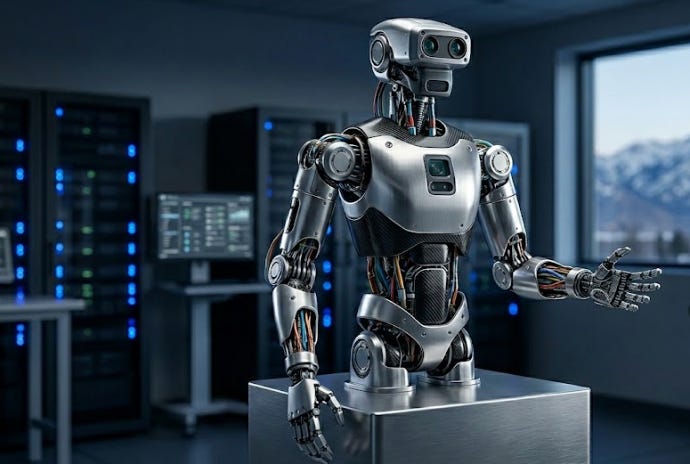
I want to explore how the impact of AI and robotics will impact American prosperity, and how current trends can serve as signals for the impending chokeholds on American progress.
GDP, our economic output, is the most important measure of human wellbeing for a society. In traditional economics, it was a function of 3 things: Land, Labor, and Capital. Over time, Land was essentially rolled into a form of Capital, leaving us with our output equation:
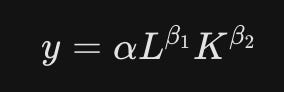
Y is output, alpha is essentially ‘productivity’, and L and K represent Labor and Capital, respectively. B1 and B2 represent the respective elasticities of output with Labor and Capital. Put simply, this measures how output responds to changes in the supply of labor and the supply of capital.
If much of human labor is replaced our heavily augmented by AI, both in the realm of intelligence (replacing white-collar work) and physical labor (automated machines, humanoid robots, etc), then Y will become significantly less responsive to changes in the supply of labor.
The implication of this is that in effect our equation could look more like: (I’m heavily abstracting here)
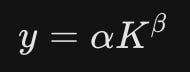
Thus the output of a country is tied to their ability to deploy capital, and their capital stock. We will have an economy of robots making robots that make stuff, with people sprinkled throughout mainly as supervisors and caretakers. Thus the constraint on our production won’t be people to do jobs, but on how many robots we have making other robots to make everything else.
When considering American output, America’s total factor productivity is unlikely to randomly plummet anytime soon, so I think we can largely avoid considering catastrophes around a fall in alpha. So the question becomes: What will prevent us from cruising towards a techno-utopia free from most forms of scarcity? To answer this, we must consider what might limit the rapid expansion of capital—land, equipment, machinery, robots—in the United States.
The litigation economy
Much has been said lately about the rise of regulation, NIMBYism, environmental lawsuits, and other procedural and legal challenges that gum up doing business. Litigation is already 4% of our GDP and rising steadily. We’re already seeing over 40% of data center projects get canceled around the country. As hostility to development increases around the country, the use of Land, a critical form of capital, could become increasingly difficult (though doing things in space could help us circumvent this).
Regulation
The AI and robotics revolution will be wrapped up in tons of intellectual property and proprietary technologies. This makes a handful of super valuable companies very likely (think Musk Industries). A struggle for power could lead to regulation in one of two ways — the incumbent firms lobby for heavy regulation of their competitors, allowing them to collect economic rents on their technological pole position, or in an attempt to kneecap a dominant player, smaller firms may regulate the winner in order to get a final shot. Either way, regulation will lead to a slowdown in the rollout of technologies that augment/replace labor to a significant degree. We’re already seeing this as cities begin to limit or cap the number of autonomous vehicles in a city.
Taxation and redistribution
In an economy where GDP is driven by capital, the owners of that capital will receive massive windfalls and thus will be taxed in order to fund the lives of everyone else. This will be a good thing and should happen to some degree. What could limit the expansion of capital however, is if the tax burden becomes too great on the most productive industries first. If the government becomes trigger happy with AI-levies and robot taxes, the very golden-geese whose rapid growth was set to spur an AI and GDP revolution could become heavily delayed.
These are abstract projections, and there is much that’s uncertain. But as policymakers consider the implications of AI and robotics on our economy an society, a keen eye on future snags that could hinder the growth of America’s Capital stock is essential to robust prosperity.